

How Many Frames A Moving Hold 3d Animation
Recently I've seen a lot of discussion between animators regarding how fast yous should be animating. How many seconds per day demand to be complete? What's "normal" in the manufacture? Are you going also slow? Let'southward footstep back and take a await to run across if we tin set the record straight.
Kickoff it'south important to understand that "animation" is a very broad term. If you lot're attempting to do very limited Flash animation, you're probably going to seem to produce piece of work at cheetah-speeds compared to a frame by frame animator drawing by mitt. Also some animators simply breathing faster than others. That doesn't make them better or worse, it is just how they piece of work. And finally the actual SHOT you are animating is going to determine a lot besides. Is information technology simple, without much motion? Is the grapheme performing an intense action with a huge amount of objects involved? On top of all that, there'due south framerate to consider!
As long every bit we go into the discussion understanding that at that place are so many variables information technology's nearly incommunicable to truly have a "normal speed," we tin can showtime to compare the apples and oranges that are "how much animation in a detail amount of fourth dimension."
Ye Olden Days
Taking a look into the past, blitheness was once measured in feet. That'south because everything was done on actual flick (no digital) and so instead of referring to private frames regarding productivity, people only said "I managed 2 Anxiety of work this week."

A pes of picture show is equal to 16 frames. Since most blitheness for moving picture runs at 24 frames per second, a foot of blitheness is over one second if on 2s, and under a second if done on 1s.
Editor'southward Note: Equally Geoff points out in the comments, it is 16 frames regardless of if it's on ones or twos. It would merely be only 8 drawings if on 2s, vs. the full 16 drawings on ones. Cheers for the heads up, Geoff! Deplorable I missed that.
In the earlier days of Disney Feature Animation, information technology was non uncommon for the animators to produce 3.75 feet of animation per 24-hour interval. That comes out to nigh 14 seconds of animation a week.
And that'southward nix compared to Disney'southward FASTEST animators, who could blaze trails at 23-24 seconds of feature quality animation per week.
How does that compare to the current day and age, though? Surely with the technology nosotros have now we go faster, right?
Animation Today
Truth be told, fourteen seconds per calendar week of film-quality blitheness is unheard of today. If asked to effort that, most animators in the manufacture would laugh (or cry) and say it couldn't be done. Today it'due south not uncommon for feature animation (in 3D) to go at the pace of about 3-4 seconds of animation per week. A far cry from the fourteen seconds that the Nine Old Men would churn out.
Meanwhile if you're looking at straight-to-video film, it'southward often in the 12-18 seconds per week range. Closer to the olden days of 14 second, but with a huge drop in quality by comparison. If yous've ever seen a film produced straight to video, it can't compare to the stuff that hits the big screen.
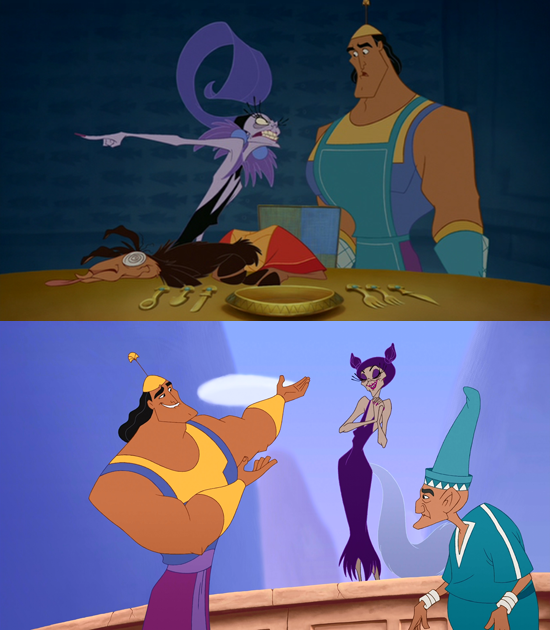
Side note: If you ever want something terrific to report, check out The Emperor's New Groove directly compared to Kronk'southward New Groove. The difference is staggering.
Television Animation varies a great deal, and as well depends on where information technology'southward beingness produced. In the US, some studios request their animators maintain around 25-xxx seconds of animation a week, especially if it is limited fashion. That's not particularly troublesome to do since limited animation has a large number of holds and focuses heavily on dialogue.
Game animation besides varies a great bargain, just speaking with a few folks at various studios information technology seems similar "normal" ranges between 5-10 seconds per day, or 25-l seconds a week. Something more important drops it downwardly to ii-4 seconds a day, and during crunch time it can increase to 10-20.
[the_ad_placement id="advert-in-article"]
Variables Variables Everywhere
Once more, everything above is based on such a diversity of situations that information technology would be foolish to say there was a hard and fast dominion about speed in which to animate. The biggest variable is going to ever be quality. Quality will dictate your speed. Ferdinand and I once did a 48 60 minutes animation contest together, and past the stop we were producing 10 seconds of animation an hour! Withal the quality was rather terrible at that point. Such is a deadline of 2 days.
On the flip side, the Disney animators of days gone by could, and often did, sit for hours or even days at their desk contemplating a SINGLE FRAME. Keyframes are so important, as story-telling drawings, that no amount of time was gear up to make sure they were spot on. The poses of such frames required near-perfection, so rushing was not an option.

The last discussion is that speed actually only matters "whence a borderline fast approacheth." If you are working at a big studio that needs things done ASAP, y'all may take to work at a much higher rate (and lower quality) than if information technology's a personal shot or curt in front of you. And when information technology's a personal short, don't WORRY well-nigh speed. Focus instead on doing the absolute best blitheness you tin can. Because at the end of the day, it's very similar to a quote past game designer Shigeru Miyamoto:
"A delayed game is eventually skillful, a bad game is bad forever."
Delay if you must, merely don't sacrifice forever just to go fast.
So how slowly or chop-chop do Yous animate? Leave a comment below and share your stories of studio work, personal work, or whatsoever crazy deadlines that caused your normal speed to shoot through the roof!

Source: https://www.animatorisland.com/how-fast-should-you-animate/
Posted by: woodendrythilite.blogspot.com
0 Response to "How Many Frames A Moving Hold 3d Animation"
Post a Comment