

What Can Be Done To Save Endangered Animals
Rhinos
Rhinos were once widespread across Africa's savannas and Asia's tropical forests. But today very few rhinos survive outside national parks and reserves. Successful conservation efforts have helped subspecies similar the greater one-horned (or Indian) rhinoceros, to increase in number. In Africa, black rhinos accept doubled in number over the past 2 decades, only full numbers are withal a fraction of the estimated 100,000 that existed in the early part of the 20th century. Increasingly, rhinos are killed by poachers for their horns. WWF works to assist governments and authorities fissure downwardly on wild fauna crime. Nosotros set up training for constabulary enforcement, rails rhino movements via transmitters and set hotlines—all to help finish poachers and build a future in which the rhinoceros can thrive.
Tigers
After a century of decline, tiger numbers are on the rise. At least three,890 tigers remain in the wild, but much more work is needed to protect this species that'southward however vulnerable to extinction. Tigers may be one of the most revered animals, simply they are also vulnerable to extinction. WWF believes we can save wild tigers. We have set a bold but doable goal of Tx2: doubling the number of tigers in the wild past 2022, when the adjacent Year of the Tiger is celebrated.
Polar Bears
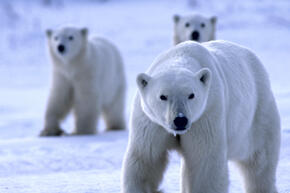
Polar bears spend the majority of near of their lives on frozen Arctic sea water ice. The loss of sea ice habitat due to climate change is at present the greatest threat to their survival. WWF aims to sustainably preserve the rich biodiversity of polar bear habitats. We work with partners and local communities to constitute a management plan for the "Last Ice Expanse" in Canada and Greenland—a region scientists believe will be preserved as bounding main ice longer than anywhere else. The plan conserves habitat for all Arctic ice dependent species and protects the cultural heritage and economic needs of local people.
Orangutans
Orangutans have experienced sharp population declines. A century ago there was likely more than than 230,000 orangutans in the wild. Today, the Bornean orangutan is estimated to number about 41,000 and the Sumatran about 7,500, and their habitats are fast disappearing. WWF has worked on orangutan conservation since the 1970s. Our efforts include conserving orangutan habitat, stopping poachers, promoting sustainable forestry and agriculture, and halting the orangutan pet trade.
Marine Turtles

Near all species of marine turtle are classified every bit endangered. Human activities—hunting, poaching, habitat destruction and adventitious capture in fishing gear—accept tipped the scales against the survival of these ancient mariners. WWF is committed to finish the decline of marine turtles and work for the recovery of the species. Our piece of work to secure a future for this species includes eliminating marine turtle bycatch from fisheries, reducing the unsustainable harvest and illegal trade in marine turtles, and stemming the loss of critical marine turtle habitats.
View All Species >
Source: https://www.worldwildlife.org/initiatives/protecting-species
Posted by: woodendrythilite.blogspot.com
0 Response to "What Can Be Done To Save Endangered Animals"
Post a Comment